

Human Resource Information System of Urdaneta City University: An Assessment Towards Its Enhanced Service Delivery
Amihan April Alcazar and Charles Andrew V. Lim
Listen to the introduction
Abstract
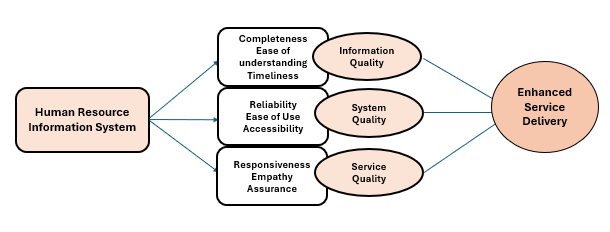
Higher education institutions increasingly rely on digital platforms such as the Human Resource Information System (HRIS) to streamline personnel administration and improve service delivery. This study assessed the HRIS of Urdaneta City University using the system quality, information quality, and service quality dimensions of the DeLone and McLean updated information systems (IS) success model. System quality focused on the reliability, ease of use, and accessibility of the HRIS; information quality covered completeness of content, ease of understanding, and timeliness; and service quality was examined through responsiveness, empathy, and assurance. The problems encountered by HRIS users were likewise identified.
 BRJ now supports Model Context Protocol
 ChatGPT
 Claude
 Gemini
Research ID
Universal Unique Research ID
Citation Generator
Cite This Research Manuscript
Alcazar, A. A. & Lim, C. A. V. (2026). Human Resource Information System of Urdaneta City University: An Assessment Towards Its Enhanced Service Delivery. Boston Research Journal of Social Sciences & Humanities, 6(4), 5-16. https://bostonresearch.org/scholarly-article/human-resource-information-system-of-urdaneta-city-university-an-assessment-towards-its-enhanced-service-delivery/
Figures
References
Abolade, D. A. (2020). Impact of e-HRM on organisational performance: A case study of selected firms in Nigeria. Journal of Human Resource Management, 8(2), 35–44.
Adams, R. (2017). The impact of HRIS on performance management and employee development. Human Resource Journal, 12(3), 45–59.
Al Mubarak, M., & Hamdan, A. (2023). Sustainable competitive advantage through technological innovation: An introduction. Springer.
Ali, & Amir. (2020). Service quality and customer satisfaction. Jurnal Intelek, 15(2).
Altbach, P. G., Reisberg, L., & Rumbley, L. E. (2019). Trends in global higher education: Tracking an academic revolution. UNESCO Publishing.
Annamdevula, S., & Bellamkonda, R. S. (2012). Development of HiEdQUAL: A scale for measuring higher education service quality. International Journal of Innovation, Management and Technology, 3(4), 412–416.
Baker, T. (2013). Challenges in adopting HRIS: Technological limitations in institutions. Information Systems Research, 8(2), 78–92.
Becker, B., & Huselid, M. (2018). The impact of HR information systems on organisational performance. Journal of Management Studies, 55(3), 456–478.
Bernardo, A. D. (2021). The role of HRIS in the Philippine corporate setting: A comprehensive overview. Journal of Business Management and Technology, 15(4), 115–130.
Bondarouk, T., & Brewster, C. (2016). Conceptualising the future of HRM and technology research. The International Journal of Human Resource Management, 27(21), 2652–2671. https://doi.org/10.1080/09585192.2016.1232296
Brown, J., & Wilson, P. (2012). Resistance to HRIS adoption: A study on employee perception and training methods. Journal of Organisational Change, 15(4), 112–126.
Cabrera, M. R. (2018). Adoption of HR information systems by SMEs in the Philippines: Challenges and benefits. International Journal of Business and IT Management, 7(2), 101–117.
Chen, X., & Zhang, Y. (2021). Cloud computing and HRIS: A pathway to overcoming technological barriers in universities. International Journal of Cloud Computing, 14(1), 25–40.
Davis, F. D. (1989). Perceived usefulness, perceived ease of use, and user acceptance of information technology. MIS Quarterly, 13(3), 319–340. https://doi.org/10.2307/249008
Delery, J. (2021). HRIS and strategic HRM: A systematic review. Strategic HR Journal, 18(1), 78–101.
DeLone, W. H., & McLean, E. R. (1992). Information systems success: The quest for the dependent variable. Information Systems Research, 3(1), 60–95. https://doi.org/10.1287/isre.3.1.60
DeLone, W. H., & McLean, E. R. (2003). The DeLone and McLean model of information systems success: A ten-year update. Journal of Management Information Systems, 19(4), 9–30. https://doi.org/10.1080/07421222.2003.11045748
DeLone, W. H., & McLean, E. R. (2016). Information systems success measurement. Foundations and Trends in Information Systems, 2(1), 1–116. https://doi.org/10.1561/2900000005
Fenech, R., Baguant, P., & Ivanov, D. (2019). The changing role of human resource management in an era of digital transformation. Journal of Management Information and Decision Sciences, 22(2), 166–175. https://www.abacademies.org/articles/the-changing-role-of-human-resource-management-in-an-era-of-digital-transformation-8154.html
Ferrell, J. (2021). The benefits of using an HRIS: Enhancing efficiency and compliance. UpSourced HR.
Fisher, S. L., & Howell, A. W. (2020). Human resource technology trends: Adoption and impact in the past decade. Journal of Applied Psychology, 105(9), 1090–1105.
Foster, L., & Grant, M. (2015). Automated recruitment processes: Enhancing fairness and efficiency through HRIS. Journal of HR Technology, 9(1), 50–63.
Garcia, H., & Torres, P. (2020). HRIS in universities: Improving employee data management and reducing inconsistencies. Higher Education Management, 18(2), 67–81.
Garcia, S., et al. (2020). Overcoming resistance to HRIS adoption: The role of training and user involvement. Journal of Business Innovation, 22(3), 102–117.
Green, T. (2019). HRIS systems: A comprehensive guide to compliance, data privacy, and legal risk management. Human Resources Today.
Guthrie, J. (2020). The digital transformation of HRM. Academy of Management Perspectives, 34(2), 123–140.
Henderson, K. (2016). Payroll accuracy and compliance through HRIS automation. Journal of Financial Management in Organisations, 11(2), 39–52.
Huselid, M. A. (2020). The role of HR analytics in talent management. Human Resource Management Review, 30(4), 567–589.
Jackson, S. E., Lepak, D. P., & Han, K. (2019). HR technology and its impact on HR service delivery. Human Resource Management Review, 29(4), 600–620.
Johnson, R. D., Lukaszewski, K. M., & Stone, D. L. (2016). The evolution of the field of human resource information systems: Co-evolution of technology and HR processes. Communications of the Association for Information Systems, 38, Article 28. https://doi.org/10.17705/1cais.03828
Jones, L., & White, R. (2014). HRIS and employee record management: Reducing paperwork and enhancing accessibility. Business and Information Systems, 17(1), 55–69.
Kant, R., & Jaiswal, D. (2017). The impact of perceived service quality dimensions on customer satisfaction: An empirical study on public sector banks in India. International Journal of Bank Marketing, 35(3), 411–430. https://doi.org/10.1108/IJBM-04-2016-0051
Kavanagh, M. J., Thite, M., & Johnson, R. D. (2019). Human resource information systems: Basics, applications, and future directions. SAGE Publications.
Kim, Y., et al. (2023). Performance management improvements through HRIS: The role of automation and transparency. Journal of Human Resource Development, 29(3), 90–105.
Kumar, A. (2018). Effect of service quality on customer loyalty and the mediating role of customer satisfaction: An empirical investigation for the telecom service industry. Journal of Management Research and Analysis, 4(4), 159–166.
Kumar, S. (2010). Data security concerns in HRIS implementation. Information Security Review, 7(4), 33–47.
Kwan, A. (2019). Key advantages of adopting HRIS in organisations. HRM Journal, 28(3), 25–30.
Lee, J. N., & Chen, Y. (2020). How HRIS facilitates employee engagement and performance: A multi-level analysis. The International Journal of Human Resource Management, 31(12), 1586–1609.
Malik, A., & De Silva, T. A. (2021). HRIS in emerging economies: The influence of socio-economic contexts on the adoption of human resource information systems. Asia Pacific Journal of Human Resources, 59(4), 539–557.
Marler, J. H., & Fisher, S. L. (2013). An evidence-based review of e-HRM and strategic human resource management. Human Resource Management Review, 23(1), 18–36. https://doi.org/10.1016/j.hrmr.2012.06.002
Marler, J. H., & Parry, E. (2016). Human resource management, strategic involvement and e-HRM technology. The International Journal of Human Resource Management, 27(19), 2233–2253. https://doi.org/10.1080/09585192.2015.1091980
Martinez, D., & Lopez, A. (2022). Payroll efficiency and fraud prevention in HRIS implementation. Journal of Financial Technology, 19(2), 45–60.
Meijer, A. (2015). E-governance innovation: Barriers and strategies. Government Information Quarterly, 32(2), 198–206. https://doi.org/10.1016/j.giq.2015.01.001
Ndou, V. (2004). E-government for developing countries: Opportunities and challenges. The Electronic Journal on Information Systems in Developing Countries, 18(1), 1–24. https://doi.org/10.1002/j.1681-4835.2004.tb00117.x
Nguyen, T., & Lee, C. (2022). Streamlining university recruitment through HRIS automation. International Journal of Human Resource Technologies, 14(4), 85–99.
Norris, D. F., & Moon, M. J. (2005). Advancing e-government at the grassroots: Tortoise or hare? Public Administration Review, 65(1), 64–75. https://doi.org/10.1111/j.1540-6210.2005.00431.x
Parasuraman, A., Zeithaml, V. A., & Berry, L. L. (1988). SERVQUAL: A multiple-item scale for measuring consumer perceptions of service quality. Journal of Retailing, 64(1), 12–40.
Parry, E., & Strohmeier, S. (2019). Digital HR transformation: Trends and challenges. HRM Review, 32(1), 90–110.
Parsa, H. G., & Shadabi, A. (2023). The impact of HRIS on organisational performance through employee engagement: Evidence from the Iranian banking sector. Journal of Business Research, 152, 330–341.
Patel, K., et al. (2021). HRIS and service delivery improvement in higher education institutions. Journal of Administrative Technology, 16(1), 120–134.
Patel, N., & Wong, L. (2020). Securing employee data: The role of HRIS in regulatory compliance. HR Magazine, 65(8), 28–34.
Podsakoff, P. M., MacKenzie, S. B., & Podsakoff, N. P. (2020). HR technology adoption in higher education. Public Sector HR Review, 12(3), 245–267.
Robinson, A. (2020). Leveraging HRIS to streamline compliance and protect employee data. Human Resources Today.
Rubaii-Barrett, N., & Wise, L. R. (2008). Disability access and e-government: An empirical analysis of state practices. Journal of Disability Policy Studies, 19(1), 52–64. https://doi.org/10.1177/1044207307311533
Singh, R., & Sharma, N. (2023). Advancements in HRIS security: Encryption and multi-factor authentication. Journal of Information Security, 27(2), 51–67.
Smith, J., & Brown, L. (2015). HRIS and university efficiency: Automation and decision-making improvements. Higher Education Administration Journal, 14(1), 35–50.
Stone, D. L., & Deadrick, D. L. (2015). Challenges and opportunities affecting the future of human resource management. Human Resource Management Review, 25(2), 139–145. https://doi.org/10.1016/j.hrmr.2015.01.003
Taylor, R., & Lee, S. (2023). Enhancing compliance through HR technology: The impact of HRIS on business practices. Journal of Business Compliance, 15(2), 33–50.
Copyright
© 2026 Alcazar and Lim. This is an open-access article distributed under the terms of the Creative Commons Attribution License (CC BY 4.0). The use, distribution or reproduction in other forums is permitted, provided the original author(s) or licensor are credited and that the original publication in this journal is cited, in accordance with accepted academic practice. No use, distribution or reproduction is permitted which does not comply with these terms.
Journal compilation © 2026 Boston Research Journals.
*Correspondence: Amihan April Alcazar
Disclaimer
All claims expressed in this article are solely those of the authors and do not necessarily represent those of their affiliated organizations, or those of the publisher, the editors and the reviewers. Any product that may be evaluated in this article or claim that may be made by its manufacturer is not guaranteed or endorsed by the publisher.