

Investment Decision-Making Model Applied to Upstream Projects Under Risks and Uncertainties
Rodrigo Gandra and Helder Queiroz Pinto Júnior
Listen to the introduction
Abstract
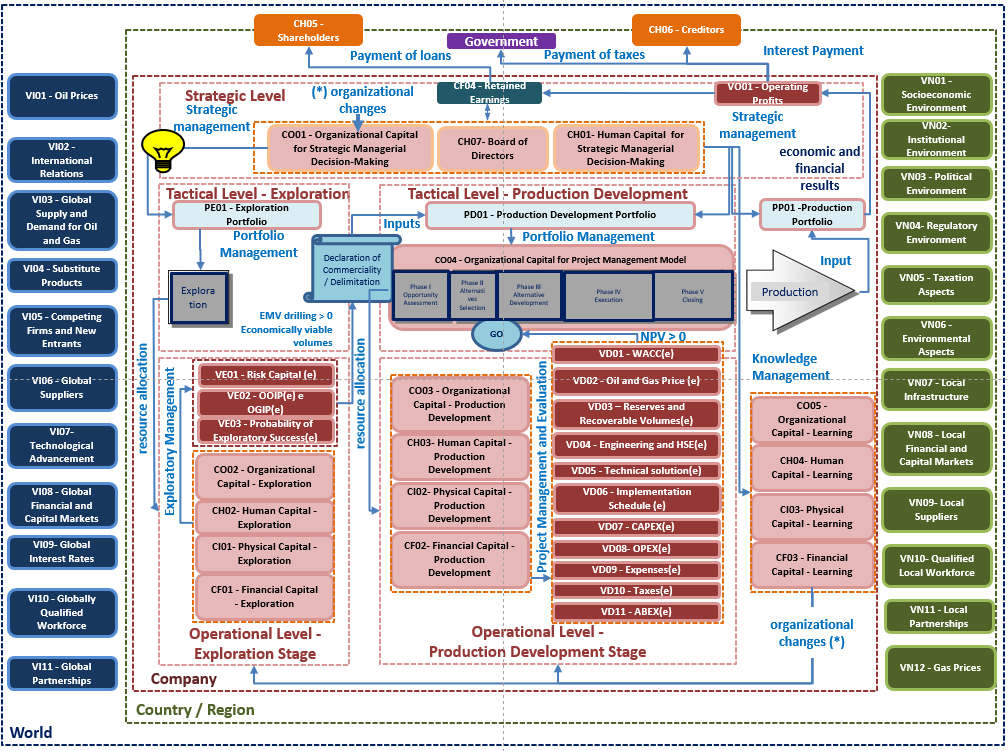
A substantial portion of the literature on organizational routines has traditionally focused on the stability and transformation of organizational operational activities. This study extends this perspective by emphasizing that organizational routines may also play a significant role in investment decision-making processes within oil companies, particularly in the upstream segment of the oil and gas industry. Based on technical, business and academic literature an Investment Decision-Making Model was developed to illustrate how organizational routines support strategic investment decision-making related to new capital assets under conditions of risk and uncertainty in this segment. Furthermore, the study identifies and discusses the principal macroprocesses (higher-level routines) employed within the upstream sector.
 BRJ now supports Model Context Protocol
 ChatGPT
 Claude
 Gemini
Research ID
Universal Unique Research ID
Citation Generator
Cite This Research Manuscript
Gandra, R. & Júnior, H. Q. P. (2026). Investment Decision-Making Model Applied to Upstream Projects Under Risks and Uncertainties. Boston Research Journal of Social Sciences & Humanities, 6(3), 27-53. https://bostonresearch.org/scholarly-article/investment-decision-making-model-applied-to-upstream-projects-under-risks-and-uncertainties/
Figures
References
Adekunle, S. (2006). Applying integrated project-management methodology to hydrocarbon-portfolio analysis and optimization (SPE Paper No. 100967-MS). Society of Petroleum Engineers. https://doi.org/10.2118/100967-MS
Aramayo, J. L. S., da Silveira, R. R., de Almeida, M. R., & Dantas, T. N. de C. (2013). A conceptual model for project management of exploration and production in the oil and gas industry: The case of a Brazilian company. International Journal of Project Management, 31(4), 589–601. https://doi.org/10.1016/j.ijproman.2012.09.012
Arrow, K. J. (1965). Aspects of the theory of risk bearing. Yrjö Jahnssonin Säätiö.
Ashforth, B. E., & Fried, Y. (1988). The mindlessness of organizational behaviors. Human Relations, 41(4), 305–329. https://doi.org/10.1177/001872678804100403
Asrilhant, B., Meadows, M., & Dyson, R. G. (2006). Techniques to support successful strategic project management in the UK upstream oil and gas sector. European Management Journal, 24(2–3), 214–225. https://doi.org/10.1016/j.emj.2006.03.007
Badiru, A. B., & Osisanya, S. O. (2013). Project management for the oil and gas industry: A world system approach. CRC Press.
Barbosa, P., Pinheiro, N., & Santos Junior, W. (2013, October 23–26). Metodologia FEL: Sua importância na avaliação de riscos e redução de impactos em escopo, tempo e custo de projetos complexos de engenharia [Paper presentation]. XXXIII Encontro Nacional de Engenharia de Produção (ENEGEP), Salvador, BA, Brazil.
Barney, J. (1991). Firm resources and sustained competitive advantage. Journal of Management, 17(1), 99–120. https://doi.org/10.1177/014920639101700108
Barney, J. B. (1996). Gaining and sustaining competitive advantage. Addison-Wesley.
Becker, M. C. (2000). The concept of routines twenty years after Nelson and Winter (1982): A review of the literature(DRUID Working Paper No. 03-06). Danish Research Unit for Industrial Dynamics.
Becker, M. C. (2004). Organizational routines: A review of the literature. Industrial and Corporate Change, 13(4), 643–677. https://doi.org/10.1093/icc/dth026
Becker, M. C. (2010). The past, present and future of organizational routines: Introduction to the Handbook of Organizational Routines. In M. C. Becker (Ed.), Handbook of organizational routines (pp. 3–14). Edward Elgar Publishing.
Becker, M. C., & Knudsen, T. (2005). The role of routines in reducing pervasive uncertainty. Journal of Business Research, 58(6), 746–757. https://doi.org/10.1016/j.jbusres.2003.09.008
Belaid, F. (2011). Decision-making process for project portfolio management. International Journal of Services Operations and Informatics, 6(1–2), 160–181. https://doi.org/10.1504/IJSOI.2011.038323
Bertels, S., Howard-Grenville, J., & Pek, S. (2016). Cultural molding, shielding, and shoring at Oilco: The role of culture in the integration of routines. Organization Science, 27(3), 573–593. https://doi.org/10.1287/orsc.2016.1052
Chang, H.-J., & Evans, P. (2005). The role of institutions in economic change. In S. De Paula & G. Dymski (Eds.), Reimagining growth: Institutions, development, and society (pp. 99–129). Zed Books.
Cohen, M. D., Burkhart, R., Dosi, G., Egidi, M., Marengo, L., Warglien, M., & Winter, S. (1996). Routines and other recurring action patterns of organizations: Contemporary research issues (IIASA Working Paper WP-96-025). International Institute for Applied Systems Analysis.
Cyert, R. M., & March, J. G. (1963). A behavioral theory of the firm. Prentice-Hall. (Reprinted by Martino Publishing, 2013).
Dosi, G., Nelson, R. R., & Winter, S. G. (2000). Introduction: The nature and dynamics of organizational capabilities. In G. Dosi, R. R. Nelson, & S. G. Winter (Eds.), The nature and dynamics of organizational capabilities (pp. 1–22). Oxford University Press.
Feiler, P., & Teece, D. (2014). Case study, dynamic capabilities and upstream strategy: Supermajor EXP. Energy Strategy Reviews, 3, 14–20. https://doi.org/10.1016/j.esr.2014.03.001
Feldman, M. S. (2000). Organizational routines as a source of continuous change. Organization Science, 11(6), 611–629. https://doi.org/10.1287/orsc.11.6.611.12529
Feldman, M. S., Pentland, B. T., D'Adderio, L., & Lazaric, N. (2016). Beyond routines as things: Introduction to the special issue on routine dynamics. Organization Science, 27(3), 505–513. https://doi.org/10.1287/orsc.2016.1070
Galli, A., Armstrong, M., & Jehl, B. (1999). Comparison of three methods for evaluating oil projects. Journal of Petroleum Technology, 51(10), 44–49. https://doi.org/10.2118/57683-JPT
Gandra, R. (2019). Rotinas organizacionais e decisões de investimento sob riscos e incertezas: Uma análise do segmento de exploração e produção da indústria de óleo e gás [Doctoral dissertation, Universidade Federal do Rio de Janeiro]. PPED Repository.
Gandra, R. (2022). Conciliando os conceitos de rotinas organizacionais e instituições: Uma abordagem teórica. Desenvolvimento em Debate, 10(1), 81–103.
Gandra, R., & Pinto Junior, H. (2021). Rotinas organizacionais nas decisões de investimento no segmento de upstream da indústria de óleo e gás. Revista Produção Online, 21(4), 1051–1080. https://doi.org/10.14488/1676-1901.v21i4.4326
Gandra, R., & Pinto Junior, H. (2023). Modelo aplicado aos processos de tomada de decisões de investimento no segmento de exploração e produção da indústria de óleo e gás em ambiente de riscos e incertezas. Economia e Sociedade, 32(1), 103–134. https://doi.org/10.1590/1982-3533.2022v32n1art05
Garcia, R., Lessard, D., & Singh, A. (2014). Strategic partnering in oil and gas: A capabilities perspective. Energy Strategy Reviews, 3, 21–29. https://doi.org/10.1016/j.esr.2014.02.001
Grant, R. M. (2003). Strategic planning in a turbulent environment: Evidence from the oil majors. Strategic Management Journal, 24(6), 491–517. https://doi.org/10.1002/smj.314
Greve, H. R. (2010). Organizational routines and performance feedback. In M. C. Becker (Ed.), Handbook of organizational routines (pp. 187–204). Edward Elgar Publishing.
Heiner, R. A. (1983). The origin of predictable behavior. The American Economic Review, 73(4), 560–595.
Hodgson, G. M. (2003). The mystery of the routine: The Darwinian destiny of An Evolutionary Theory of Economic Change. Revue Économique, 54(2), 355–384. https://doi.org/10.3917/reco.542.0355
Hodgson, G. M. (2010). The concept of a routine. In M. C. Becker (Ed.), Handbook of organizational routines (pp. 15–28). Edward Elgar Publishing.
Hodgson, G. M., & Knudsen, T. (2004a). The complex evolution of a simple traffic convention: The functions and implications of habit. Journal of Economic Behavior & Organization, 54(1), 19–47. https://doi.org/10.1016/j.jebo.2003.04.001
Hodgson, G. M., & Knudsen, T. (2004b). The firm as an interactor: Firms as vehicles for habits and routines. Journal of Evolutionary Economics, 14(3), 281–307. https://doi.org/10.1007/s00191-004-0213-x
Howard-Grenville, J. A. (2005). The persistence of flexible organizational routines: The role of agency and organizational context. Organization Science, 16(6), 618–636. https://doi.org/10.1287/orsc.1050.0150
Keynes, J. M. (1983). A teoria geral do emprego, do juro e da moeda [The general theory of employment, interest and money]. Editora Abril Cultural. (Original work published 1936)
Knight, F. H. (1964). Risk, uncertainty and profit. Sentry Press. (Original work published 1921)
Knudsen, T. (2010). Organizational routines in evolutionary theory. In M. C. Becker (Ed.), Handbook of organizational routines (pp. 125–151). Edward Elgar Publishing.
Langlois, R. N. (1992). Transaction cost economics in real time. Industrial and Corporate Change, 1(1), 99–127. https://doi.org/10.1093/icc/1.1.99
Levitt, B., & March, J. G. (1988). Organizational learning. Annual Review of Sociology, 14(1), 319–340. https://doi.org/10.1146/annurev.so.14.080188.001535
Luce, R. D., & Raiffa, H. (1957). Games and decisions: Introduction and critical survey. John Wiley & Sons.
Macmillan, F. (2000). Risk, uncertainty and investment decision-making in the upstream oil and gas industry [Doctoral dissertation, University of Aberdeen].
March, J. G., & Shapira, Z. (1987). Managerial perspectives on risk and risk taking. Management Science, 33(11), 1404–1418. https://doi.org/10.1287/mnsc.33.11.1404
March, J. G., & Simon, H. A. (1993). Organizations (2nd ed.). Blackwell. (Original work published 1958)
Margueron, M. V. (2003). Processo de tomada de decisão sob incerteza em investimentos internacionais na exploração & produção de petróleo: Uma abordagem multicritério [Master's thesis, Universidade Federal do Rio de Janeiro].
Merrow, E. W. (2012). Oil and gas industry megaprojects: Our recent track record. Oil and Gas Facilities, 1(2), 38–42. https://doi.org/10.2118/153695-PA
Milagres, R. (2011). Rotinas – Uma revisão teórica. Revista Brasileira de Inovação, 10(1), 161–196. https://doi.org/10.20396/rbi.v10i1.8649013
Milani Junior, A., Bomtempo, J. V., & Pinto Junior, H. Q. (2005). Processo decisório na exploração e produção de petróleo. Revista Produção Online, 5(3), 8–32.
Milani Junior, A., Pinto Junior, H. Q., & Bomtempo, J. V. (2007). A indústria do petróleo como uma organização complexa: Modelagem de negócios e processo decisório. Produção, 17(1), 8–32. https://doi.org/10.1590/S0103-65132007000100002
Miner, A. S., Ciuchta, M. P., & Gong, Y. (2010). Organizational routines and organizational learning. In M. C. Becker (Ed.), Handbook of organizational routines (pp. 152–186). Edward Elgar Publishing.
Motta, O. M., Quelhas, O. L. G., & de Farias Filho, J. R. (2011). Alinhando os objetivos técnicos do projeto às estratégias de negócio: Contribuição da metodologia FEL no pré-planejamento de grandes empreendimentos. Revista Gestão Industrial, 7(4), 99–117. https://doi.org/10.3895/S1808-04482011000400006
Motta, O. M., Quelhas, O. L. G., de Farias Filho, J. R., França, S. L. B., & Meiriño, M. J. (2014). Megaprojects front-end planning: The case of Brazilian organizations of engineering and construction. American Journal of Industrial and Business Management, 4(8), 401–412. https://doi.org/10.4236/ajibm.2014.48049
Nelson, R. R. (1995). Recent evolutionary theorizing about economic change. Journal of Economic Literature, 33(1), 48–90.
Nelson, R. R., & Sampat, B. N. (2001). Making sense of institutions as a factor shaping economic performance. Revista de Economía Institucional, 3(5), 17–51.
Nelson, R. R., & Winter, S. G. (2005). Uma teoria evolucionária da mudança econômica [An evolutionary theory of economic change]. Editora da Unicamp. (Original work published 1982)
Nepomuceno Filho, F., & Suslick, S. B. (2000). Alocação de recursos financeiros em projetos de risco na exploração de petróleo. Revista de Administração de Empresas, 40(1), 63–75. https://doi.org/10.1590/S0034-75902000000100008
Newendorp, P., & Schuyler, J. (2000). Decision analysis for petroleum exploration (2nd ed.). Planning Press.
Penrose, E. (2009). The theory of the growth of the firm (4th ed.). Oxford University Press. (Original work published 1959)
Pentland, B. T., & Hærem, T. (2015). Organizational routines as patterns of action: Implications for organizational behavior. Annual Review of Organizational Psychology and Organizational Behavior, 2(1), 465–487. https://doi.org/10.1146/annurev-orgpsych-032414-111412
Pentland, B. T., Feldman, M. S., Becker, M. C., & Liu, P. (2012). Dynamics of organizational routines: A generative model. Journal of Management Studies, 49(8), 1484–1508. https://doi.org/10.1111/j.1467-6486.2012.01064.x
Pisano, G. P. (2017). Toward a prescriptive theory of dynamic capabilities: Connecting strategic choice, learning, and competition. Industrial and Corporate Change, 26(5), 747–762. https://doi.org/10.1093/icc/dtx026
Porter, M. E. (1998). Competitive strategy: Techniques for analyzing industries and competitors. Free Press. (Original work published 1980)
Pratt, J. W. (1964). Risk aversion in the small and in the large. Econometrica, 32(1/2), 122–136. https://doi.org/10.2307/1913738
Project Management Institute. (2008). The standard for portfolio management (2nd ed.). Project Management Institute.
Project Management Institute. (2017). Um guia do conhecimento em gerenciamento de projetos (Guia PMBOK) (6th ed.). Project Management Institute.
Schumpeter, J. A. (1961). Capitalismo, socialismo e democracia [Capitalism, socialism and democracy]. Editora Fundo de Cultura. (Original work published 1942)
Shuen, A., Feiler, P. F., & Teece, D. J. (2014). Dynamic capabilities in the upstream oil and gas sector: Managing next generation competition. Energy Strategy Reviews, 3, 5–13. https://doi.org/10.1016/j.esr.2014.05.002
Simon, H. A. (1957). Administrative behavior: A study of decision-making processes in administrative organization (2nd ed.). Macmillan.
Simon, H. A. (1959). Theories of decision-making in economics and behavioral science. The American Economic Review, 49(3), 253–283.
Simon, H. A. (1993). Altruism and economics. The American Economic Review, 83(2), 156–161.
Sterman, J. D. (2000). Business dynamics: Systems thinking and modeling for a complex world. McGraw-Hill.
Suslick, S. B., Schiozer, D., & Rodriguez, M. R. (2009). Uncertainty and risk analysis in petroleum exploration and production. Terræ, 6(1), 30–41.
Teece, D. J. (2007). Explicating dynamic capabilities: The nature and microfoundations of (sustainable) enterprise performance. Strategic Management Journal, 28(13), 1319–1350. https://doi.org/10.1002/smj.640
Teece, D. J. (2014). The foundations of enterprise performance: Dynamic and ordinary capabilities in an (economic) theory of firms. Academy of Management Perspectives, 28(4), 328–352. https://doi.org/10.5465/amp.2013.0116
Teece, D. J. (2017). A capability theory of the firm: An economics and (strategic) management perspective (Working Paper Series No. 20). Tusher Center on Intellectual Capital.
Teece, D. J., & Pisano, G. (1994). The dynamic capabilities of firms: An introduction. Industrial and Corporate Change, 3(3), 537–556. https://doi.org/10.1093/icc/3.3.537
Teece, D. J., Pisano, G., & Shuen, A. (1997). Dynamic capabilities and strategic management. Strategic Management Journal, 18(7), 509–533. https://doi.org/10.1002/(SICI)1097-0266(199708)18:7<509::AID-SMJ882>3.0.CO;2-Z
van der Weijde, G. (2008). Front-end loading in the oil and gas industry: Towards a fit front-end development phase[Master's thesis, Delft University of Technology].
Veiga, É., & Silva, E. (2020). A systematic review of risk management in projects. Revista Produção Online, 20(3), 837–857. https://doi.org/10.14488/1676-1901.v20i3.3888
Winter, S. G. (1964). Economic "natural selection" and the theory of the firm. Yale Economic Essays, 4(1), 225–272.
Winter, S. G., & Szulanski, G. (2002). Replication of organizational routines: Conceptualizing of knowledge assets. In C. W. Choo & N. Bontis (Eds.), The strategic management of intellectual capital and organizational knowledge (pp. 207–221). Oxford University Press.
Zollo, M., & Winter, S. G. (2002). Deliberate learning and the evolution of dynamic capabilities. Organization Science, 13(3), 339–351. https://doi.org/10.1287/orsc.13.3.339.2780
Copyright
© 2026 Gandra and Júnior. This is an open-access article distributed under the terms of the Creative Commons Attribution License (CC BY 4.0). The use, distribution or reproduction in other forums is permitted, provided the original author(s) or licensor are credited and that the original publication in this journal is cited, in accordance with accepted academic practice. No use, distribution or reproduction is permitted which does not comply with these terms.
Journal compilation © 2026 Boston Research Journals.
*Correspondence: Rodrigo Gandra
Disclaimer
All claims expressed in this article are solely those of the authors and do not necessarily represent those of their affiliated organizations, or those of the publisher, the editors and the reviewers. Any product that may be evaluated in this article or claim that may be made by its manufacturer is not guaranteed or endorsed by the publisher.