

Validity and Reliability of the KORR Metabolic System During Submaximal and Maximal Exercise
Craig Broeder, Anton Simms, Alexander H.K Montoye and Aiste Petraityte
Listen to the introduction
Abstract
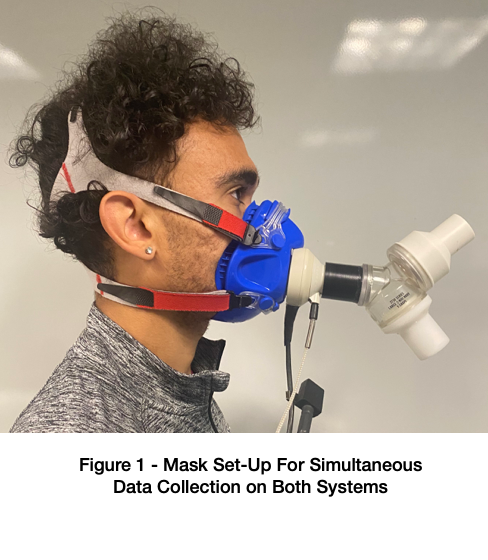
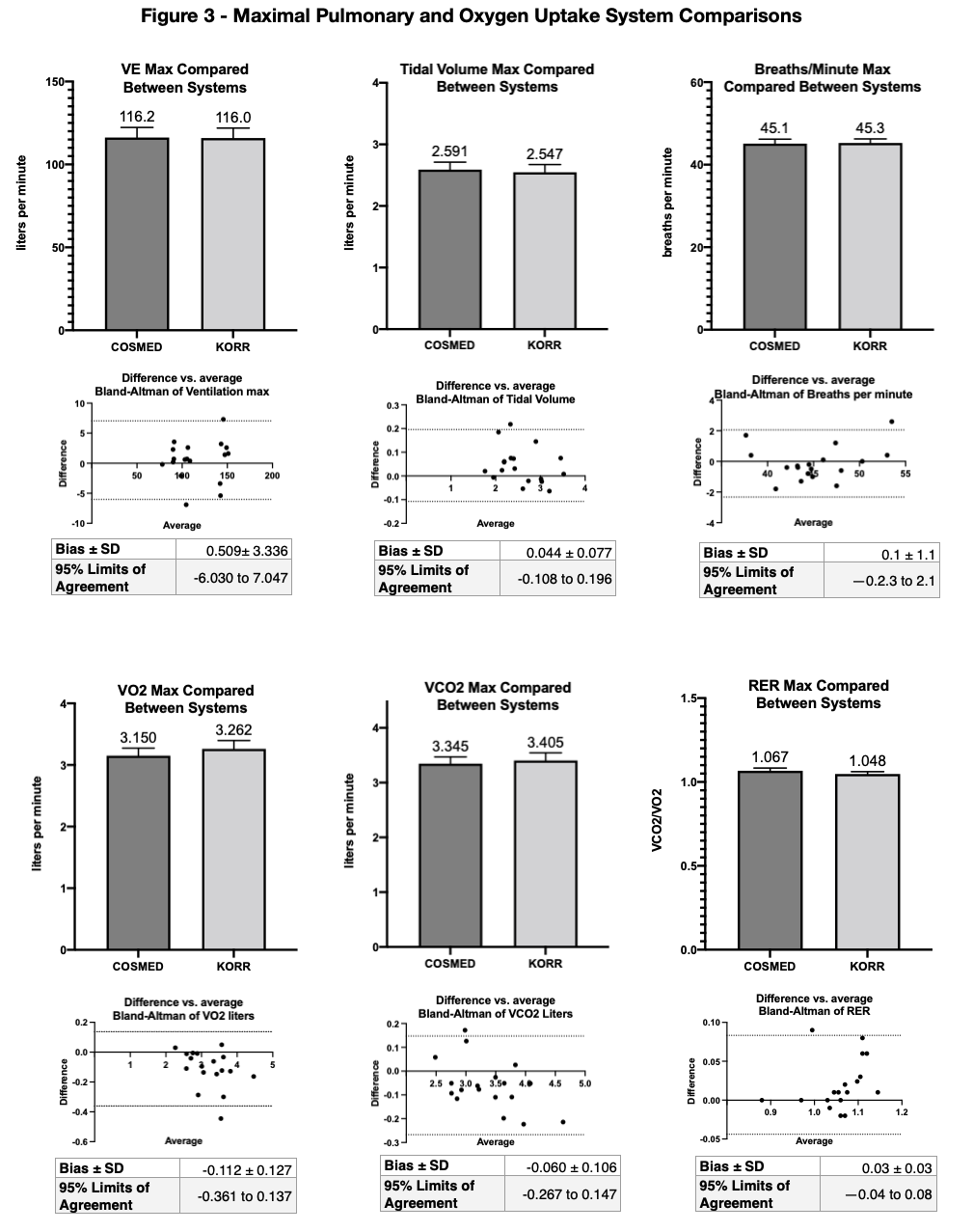
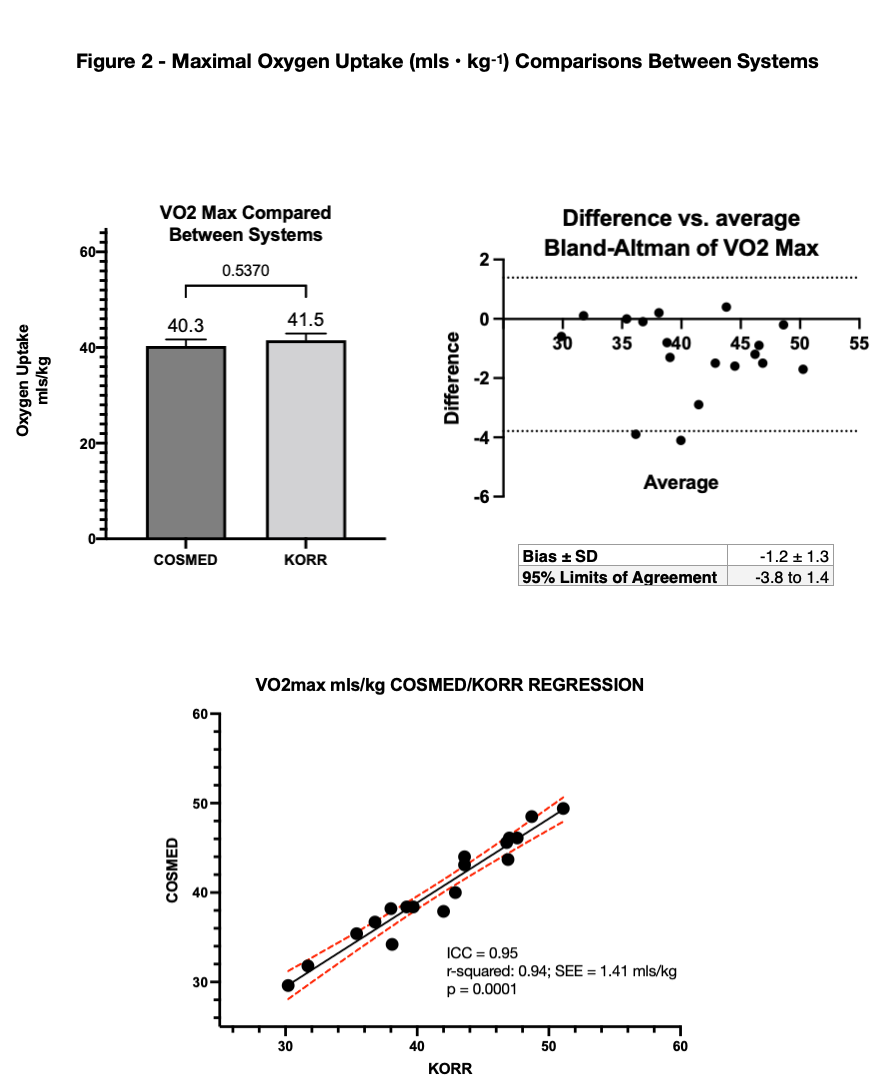
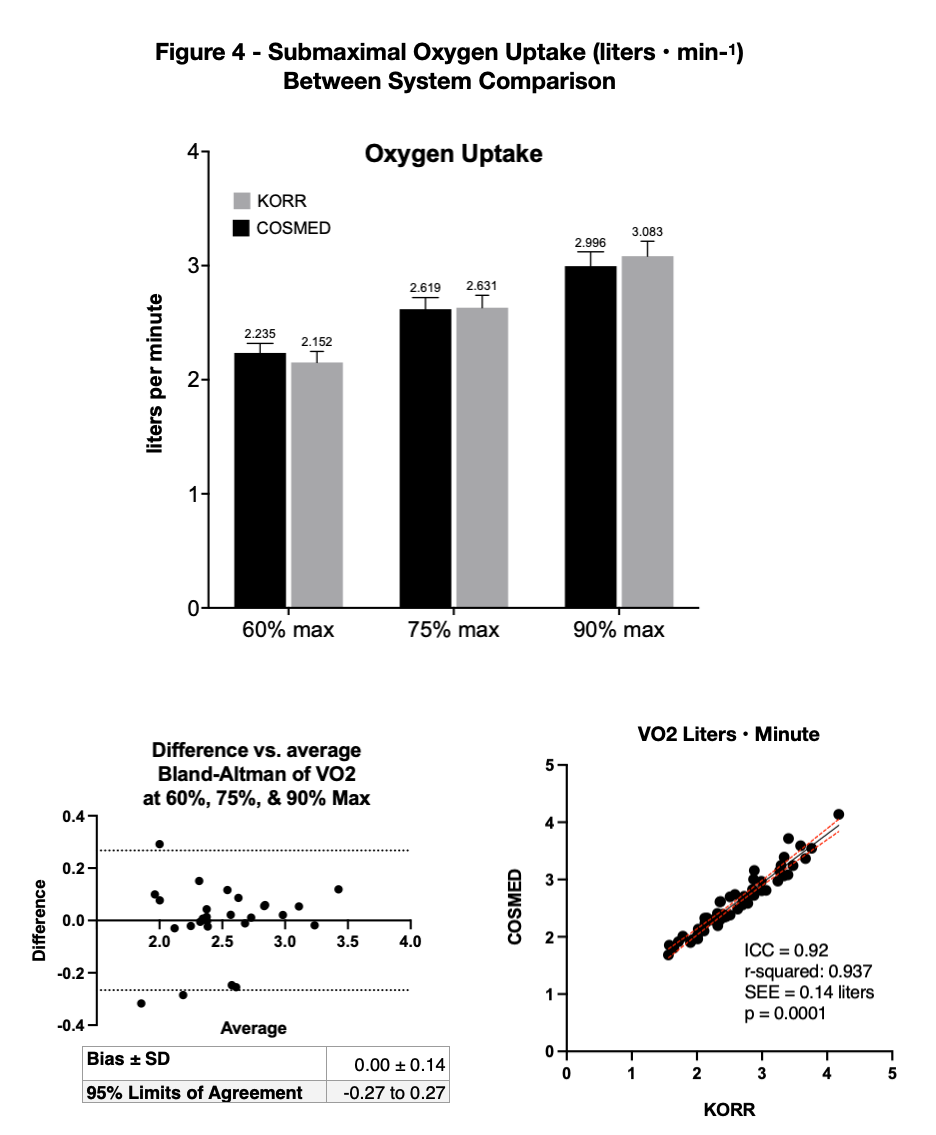
This study compared the KORR CardioCoach Pro metabolic system to the COSMED clinical-research system during submaximal steady-state exercise and maximal aerobic capacity. Eighteen adults (50.3 ± 11.9 yrs old, 78.6 ± 10.6 kg, 25.6 ± 8.0 % body fat, and cardiovascular fitness rank equaled 83rd percentile) completed the validation phase while nine subjects were randomly assigned to the test-retest phase. Metabolic data was collected simultaneously with both systems. VO2 max (mls • kg • min-1) was not significantly different between systems (COSMED = 40.3 ± 5.7; KORR = 41.5 ± 5.8; ES = 0.21). There were no between-system differences for max ventilation, tidal volume, respiration rate, carbon dioxide production, or respiratory exchange ratio. The intra-class correlation (ICC) and regression slope between the two systems showed excellent agreement (ICC: 0.95; r-squared = 0.94; p = 0.0001; SEE = 1.4 mls • kg-1 • min-1). During submaximal exercise, no statistical between-system differences were observed. The intra-class correlation (ICC) and regression slope between the two systems showed excellent agreement (ICC: 0.92; r-squared = 0.937; p = 0.0001; SEE = 0.058 mls • kg-1 • min-1). There results indicate the KORR metabolic system accurately measured metabolism during both submaximal and maximal cycling.
 BRJ now supports Model Context Protocol
 ChatGPT
 Claude
 Gemini
Research ID
Universal Unique Research ID
Citation Generator
Cite This Research Manuscript
Broeder, C. et al. (2026). Validity and Reliability of the KORR Metabolic System During Submaximal and Maximal Exercise. Boston Research Journal of Medical & Pharma, 1(1), 5-16. https://bostonresearch.org/scholarly-article/validity-and-reliability-of-the-korr-metabolic-system-during-submaximal-and-maximal-exercise/
Figures
References
Abul-Husn, N. S., & Kenny, E. E. (2019). Personalized medicine and the power of electronic health records. Cell, 177(1), 58–69. https://doi.org/10.1016/j.cell.2019.02.039
American College of Sports Medicine. (2021). ACSM's guidelines for exercise testing and prescription (10th ed.). Wolters Kluwer.
Bouchard, C., An, P., Rice, T., Skinner, J. S., Wilmore, J. H., Gagnon, J., Pérusse, L., Leon, A. S., & Rao, D. C. (1999). Familial aggregation of $\dot{V}\text{O}_2\text{max}$ response to exercise training: Results from the HERITAGE Family Study. Journal of Applied Physiology, 87(3), 1003–1008. https://doi.org/10.1152/jappl.1999.87.3.1003
Braig, Z. V. (2022). Personalized medicine: From diagnostic to adaptive. Biomedical Journal, 45(1), 132–142. https://doi.org/10.1016/j.bj.2019.05.004
Broeder, C. E. (2014). Metabolic testing principles for optimizing performance testing and training goals in sport and exercise. In Y. Hong (Ed.), Routledge handbook of ergonomics in sport and exercise (pp. 236–246). Routledge.
Broeder, C. E., Brenner, M., Hofman, Z., Paijmans, I. J., Thomas, E. L., & Wilmore, J. H. (1991). The metabolic consequences of low and moderate intensity exercise with or without feeding in lean and borderline obese males. International Journal of Obesity, 15(2), 95–104. http://europepmc.org/abstract/MED/2040554
Capostagno, B., Lambert, M. I., & Lamberts, R. P. (2021). Analysis of a submaximal cycle test to monitor adaptations to training: Implications for optimizing training prescription. Journal of Strength and Conditioning Research, 35(4), 924–930. https://doi.org/10.1519/JSC.0000000000003227
Ferguson, T., Olds, T., Curtis, R., Blake, H., Crozier, A. J., Dankiw, K., Dumuid, D., Kasai, D., O'Connor, E., Virgara, R., & Maher, C. (2022). Effectiveness of wearable activity trackers to increase physical activity and improve health: A systematic review of systematic reviews and meta-analyses. The Lancet Digital Health, 4(8), e615–e626. https://doi.org/10.1016/S2589-7500(22)00111-X
Goetz, L. H., & Schork, N. J. (2018). Personalized medicine: Motivation, challenges, and progress. Fertility and Sterility, 109(6), 952–963. https://doi.org/10.1016/j.fertnstert.2018.05.006
Montoye, A. H. K., Vondrasek, J. D., & Hancock, J. B., 2nd. (2020). Validity and reliability of the VO2 Master Pro for oxygen consumption and ventilation assessment. International Journal of Exercise Science, 13(4), 1382–1401. https://www.ncbi.nlm.nih.gov/pmc/articles/PMC7523887/
Navalta, J. W., Stone, W. J., & Lyons, T. S. (2019). Ethical issues relating to scientific discovery in exercise science. International Journal of Exercise Science, 12(1), 1–8. https://www.ncbi.nlm.nih.gov/pmc/articles/PMC7523901/
Nieman, D. C., Austin, M. D., Benezra, L., Pearce, S., McInnis, T., Unick, J., & Gross, S. J. (2006). Validation of Cosmed's FitMate in measuring oxygen consumption and estimating resting metabolic rate. Research in Sports Medicine, 14(2), 89–96. https://doi.org/10.1080/15438620600651512
Nieman, D. C., Austin, M. D., Chilcote, S. M., & Benezra, L. (2005). Validation of a new handheld device for measuring resting metabolic rate and oxygen consumption in children. International Journal of Sport Nutrition and Exercise Metabolism, 15(2), 186–194. https://doi.org/10.1123/ijsnem.15.2.186
Nieman, D. C., Austin, M. D., Dew, D., & Utter, A. C. (2013). Validity of COSMED's Quark CPET mixing chamber system in evaluating energy metabolism during aerobic exercise in healthy male adults. Research in Sports Medicine, 21(2), 136–145. https://doi.org/10.1080/15438627.2012.757227
Ross, R., Blair, S. N., Arena, R., Church, T. S., Després, J.-P., Franklin, B. A., Haskell, W. L., Kaminsky, L. A., Levine, B. D., Lavie, C. J., Myers, J., Niebauer, J., Sallis, R., Sawada, S. S., Sui, X., & Wisløff, U. (2016). Importance of assessing cardiorespiratory fitness in clinical practice: A case for fitness as a clinical vital sign: A scientific statement from the American Heart Association. Circulation, 134(24), e653–e699. https://doi.org/10.1161/CIR.0000000000000461
Shei, R. J., Holder, I. G., Oumsang, A. S., Paris, B. A., & Paris, H. L. (2022). Wearable activity trackers—advanced technology or advanced marketing? European Journal of Applied Physiology, 122(9), 1975–1990. https://doi.org/10.1007/s00421-022-04951-1
Singh, B., Zopf, E. M., & Howden, E. J. (2022). Effect and feasibility of wearable physical activity trackers and pedometers for increasing physical activity and improving health outcomes in cancer survivors: A systematic review and meta-analysis. Journal of Sport and Health Science, 11(2), 184–193. https://doi.org/10.1016/j.jshs.2021.07.008
Swainson, M. G., Ingle, L., & Carroll, S. (2019). Cardiorespiratory fitness as a predictor of short-term and lifetime estimated cardiovascular disease risk. Scandinavian Journal of Medicine & Science in Sports, 29(9), 1402–1413. https://doi.org/10.1111/sms.13468
Tanaka, H., Monahan, K. D., & Seals, D. R. (2001). Age-predicted maximal heart rate revisited. Journal of the American College of Cardiology, 37(1), 153–156. https://doi.org/10.1016/s0735-1097(00)01054-8
Tsekouras, Y. E., Tambalis, K. D., Sarras, S. E., Antoniou, A. K., Kokkinos, P., & Sidossis, L. S. (2019). Validity and reliability of the new portable metabolic analyzer PNOE. Frontiers in Sports and Active Living, 1, Article 24. https://doi.org/10.3389/fspor.2019.00024
Vandarakis, D., Salacinski, A. J., & Broeder, C. E. (2013). A comparison of COSMED metabolic systems for the determination of resting metabolic rate. Research in Sports Medicine, 21(2), 187–194. https://doi.org/10.1080/15438627.2012.757226
World Medical Association. (2013). World Medical Association Declaration of Helsinki: Ethical principles for medical research involving human subjects. JAMA, 310(20), 2191–2194. https://doi.org/10.1001/jama.2013.281053
Copyright
© 2026 Broeder, Simms, Montoye and Petraityte. This is an open-access article distributed under the terms of the Creative Commons Attribution License (CC BY 4.0). The use, distribution or reproduction in other forums is permitted, provided the original author(s) or licensor are credited and that the original publication in this journal is cited, in accordance with accepted academic practice. No use, distribution or reproduction is permitted which does not comply with these terms.
Journal compilation © 2026 Boston Research Journals.
*Correspondence: Craig Broeder
Disclaimer
All claims expressed in this article are solely those of the authors and do not necessarily represent those of their affiliated organizations, or those of the publisher, the editors and the reviewers. Any product that may be evaluated in this article or claim that may be made by its manufacturer is not guaranteed or endorsed by the publisher.